Field notes
A third of the harvest never reaches a plate
Pakistan loses an estimated 30–40% of its fruit and vegetable output between the field and the buyer. Almost none of that loss is caused by a lack of demand.
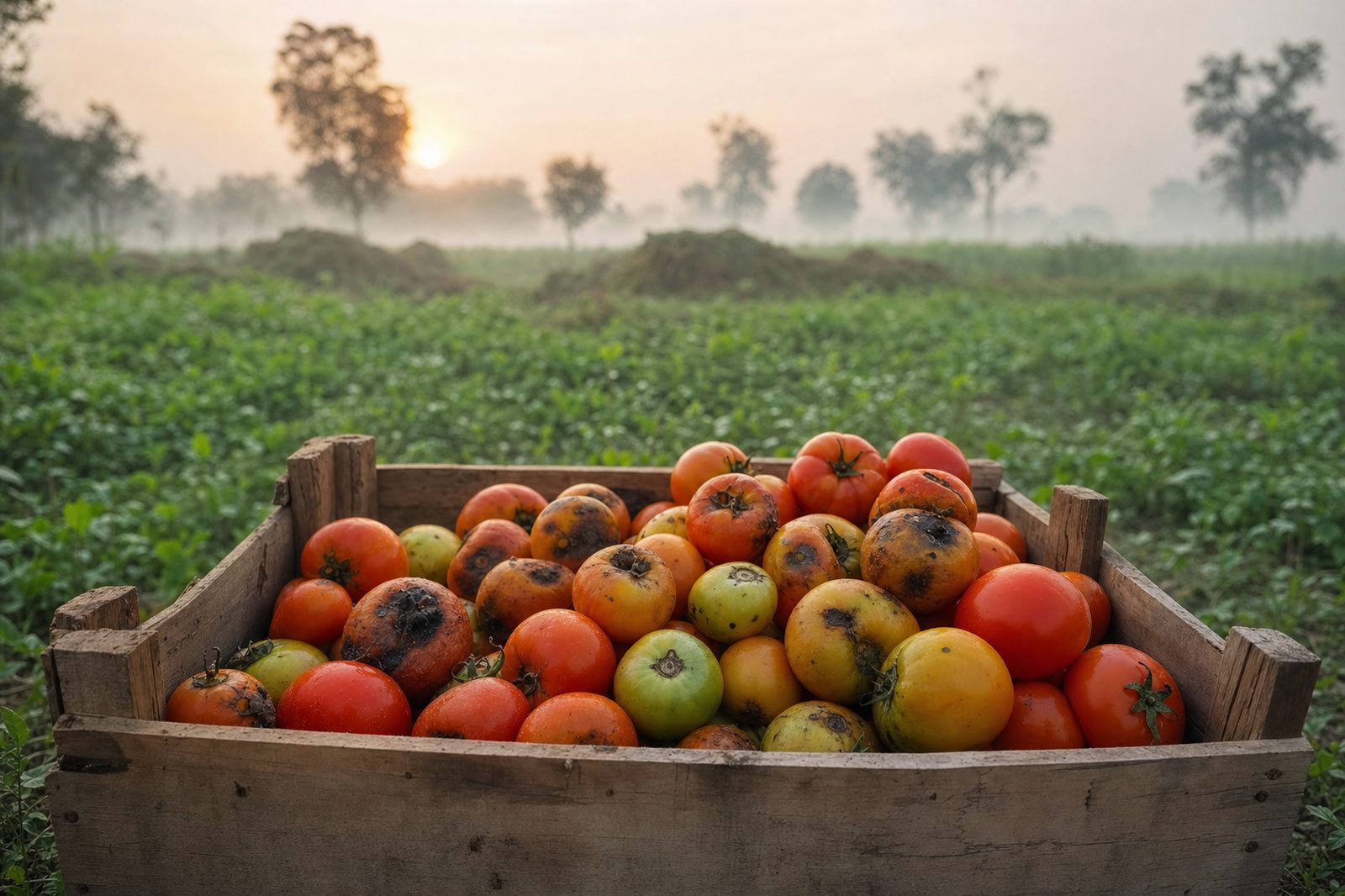
Ask a tomato grower outside Multan why he sold at the price he sold at, and the answer is almost never "that was the best price available." The answer is closer to: that was the only buyer standing in front of me while the crop was still worth something.
That distinction is the whole problem. Produce does not lose value gradually and predictably — it loses value on a clock that nobody in the chain can see. By the time a grower learns that Lahore was paying 18% more that morning, the window to act on it has closed.
Four failures, not one
When we mapped the trades our early users described, the losses clustered into four recurring failures:
- Information arrives late. Mandi rates travel by phone call and rumour. A price heard at noon may be a price from yesterday.
- Nobody prices spoilage. A market 400 km away paying 12% more is not paying more if 15% of the load arrives unsellable. Growers compare headline rates because that is the only number available.
- Coordination is fragmented. The lot lives in one WhatsApp thread, the truck in another, the buyer in a third. Nothing reconciles.
- Grade mismatch causes rejection at the gate. A load sold as Grade A that arrives as Grade B gets renegotiated on arrival — with the seller holding a perishable asset and no leverage.
Every one of those failures is a missing calculation, not a missing market.
What we decided to build instead
The instinct in agri-tech is to build a marketplace: list your produce, wait for bids. We think that solves the wrong half of the problem. A marketplace assumes the seller already knows what a good outcome looks like. Most don't — not because of any lack of skill, but because the inputs to that judgment (five markets' rates, transport cost, spoilage curve, buyer reliability) are scattered across five places.
So FreshRoute Agent is not a listing board. It's a conversation that does the arithmetic. A grower sends one message — "I have 800 kg tomatoes in Multan, ready tomorrow" — and the agent turns that into a structured lot, grades the produce from photos, compares five destination markets on spoilage-adjusted net revenue, drafts buyer outreach, quotes transport, and then stops and asks for permission before it does anything that costs money.
The number we care about
Not gross merchandise value. Not messages sent. The metric that matters is the gap between the price a seller got and the best spoilage-adjusted price that was actually reachable that day. Close that gap and the 30–40% loss figure starts to move, one lot at a time.
Lot · LOT-4192
- Crop
- Tomato
- Quantity
- 800 kg
- Location
- Multan
- Ready
- Tomorrow, 1 Sep
- Vision grade
- A · 94% confidence
- Ripeness / defects
- Optimal · 3%
Where the current build stands. Auth, orders, revenue history, reviews and Gemini-powered extraction, vision and chat are live. Mandi price tables are a static, timestamped dataset, and buyer replies and transport quotes are simulated and clearly labelled in the interface. We would rather ship an honest demo boundary than a convincing fiction.